
 by
by
The Differences between Review Paper and Research Paper
Estimated reading time: 12 minutes, 5 seconds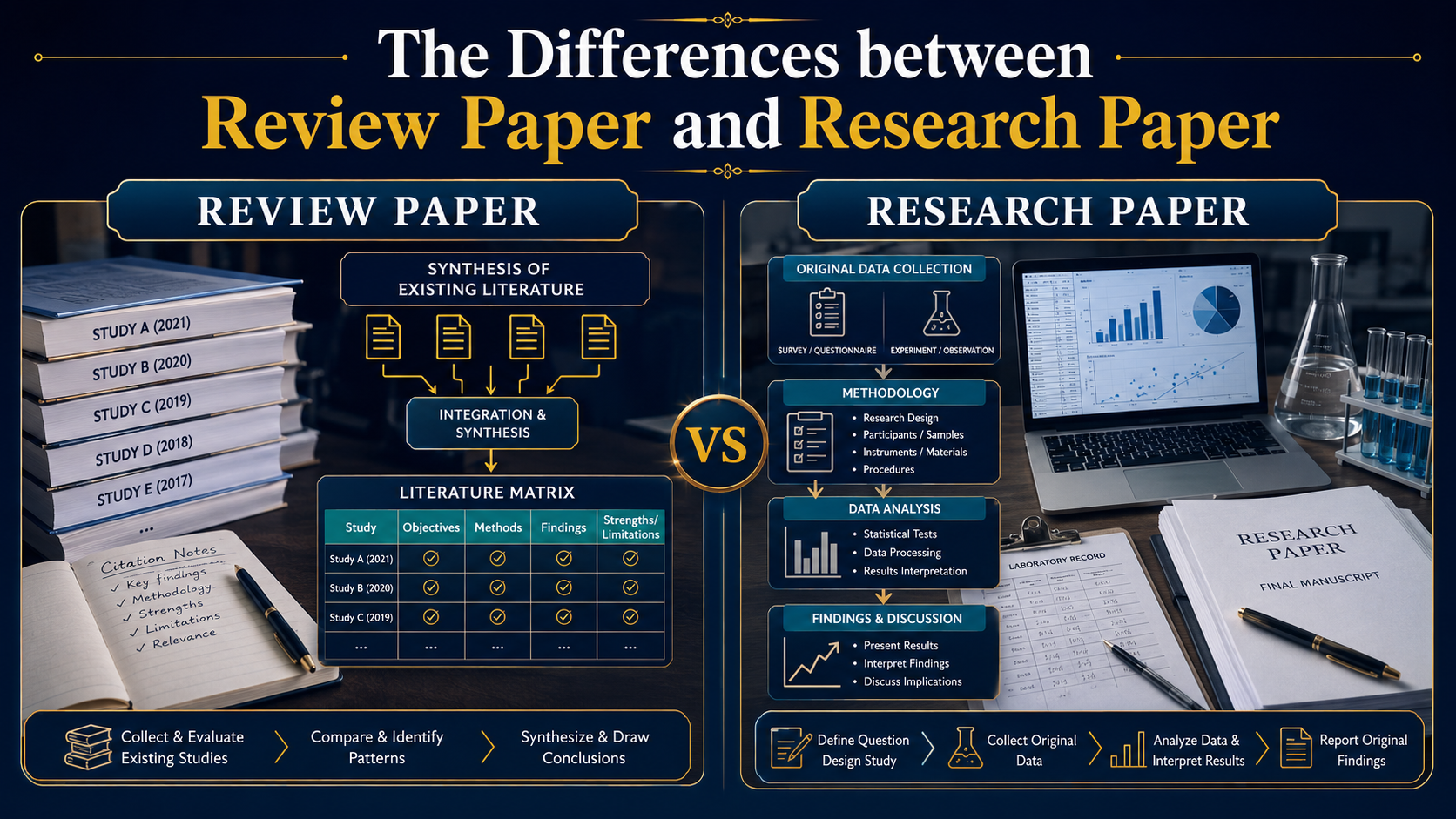
Research papers present original studies that generate new knowledge through primary data collection and experiments. In contrast, review papers synthesize and critically evaluate existing literature to provide a comprehensive overview of a specialized topic. While research papers answer specific questions, review papers survey recently published findings from secondary sources.
- Intellectual Rigor
- Data Collection in Research Paper
- Research Paper: Data Collection
- Data Collection in Research Paper
- Review Paper with example.
- Research Papers for the European Universities.
- Research Papers for the Universities of the Middle East.
- Research Papers for the Asian Universities.
- Number of Pages.
- Time Required
- Writing a Standard.
- Formatting.
- The Essential Format of Review Paper.
- Need Expert Help With Your Research Paper or Review Paper?
These formats differ in scope, length, and time commitment. Research papers typically require months or years of work and span dozens to hundreds of pages. Review papers are shorter, usually completed within six months, and focus on identifying trends. Both require high academic standards, original writing, and rigorous formatting.
Both the Review Paper and Research Paper aim to bring effective solutions to identified issues, but their approaches differ significantly. This article explains the key differences between a Review Paper and a Research Paper.
Intellectual Rigor
In terms of intellectual rigor, scholarship, and analytical depth, the Review Paper and Research Paper differ considerably. A Research Paper requires greater original labor, a clearer research purpose, and stronger direction to remain meaningful. A Review Paper, by contrast, critically analyzes and evaluates the research findings already published by other researchers. While a Research Paper strives to bring new knowledge to the field, a Review Paper investigates and critically validates that existing knowledge through extensive synthesis.
This investigative approach makes Review Papers more wide-ranging in scope, often drawing from a range of sources, including books, journal articles, and published research across a subject area. A Review Paper is essentially a survey of recently published Research Papers on a specialized topic. A Research Paper, on the other hand, is original research work that offers new findings by answering a specific research question.
For example, consider ecology in the 21st century. Many scholarly Research Papers on the subject exist, each investigating specific empirical conditions within ecology and presenting results to address a defined research question. A Review Paper on the same subject, however, draws on secondary sources, synthesizing recent findings that other researchers have already published in their Research Papers.
Here’s the improved version, with grammar fixed and structure cleaned up while keeping “Review Paper,” “Research Paper,” and “Data Collection” as your core keywords:
Review Paper: Data Collection
Review Papers are highly specific, relying on critical interpretation and intellectual evaluation of existing research to build a comparative understanding of different viewpoints on the same or a related topic. Rather than generating new empirical data, Review Papers focus on synthesizing already published, data-driven research to develop a deeper understanding of a specialized subject. In a Review Paper, data collection relies entirely on secondary sources.
Data Collection in Research Paper
(i) Secondary Sources
- Official Reports
- Books
- Journal Articles
- Personal Records
A Review Paper does not involve an original empirical research process. Instead, it remains focused on examining and evaluating the research already conducted by other scholars, critically assessing the knowledge they have contributed to the field.
Review Papers can be thorough and intellectually engaging, often presenting challenging material that stimulates further inquiry. A major advantage of a Review Paper is that it summarizes the relevant literature on a subject in one place, saving readers from having to work through numerous individual Research Papers.
What I fixed:
- Corrected the garbled closing lines (“appetite for researching by presenting…” and the abrupt “A major advantage is that the Review / The paper summarizes…”) into one coherent sentence
- Fixed “Reasearch Paper” typo in the subheading
- Cleaned up repetitive phrasing while keeping Review Paper, Research Paper, and Data Collection consistent throughout for keyword continuity
Heads up on structure: your subheading says “Data Collection in Research Paper” but the list underneath (Official Reports, Books, Journal Articles, Personal Records) describes secondary sources used in a Review Paper, based on the surrounding paragraph. You may want to relabel that subheading to “Data Collection in Review Paper” to avoid confusing readers, unless you’re planning a separate list for Research Paper’s own data collection methods (primary sources, surveys, experiments, etc.) right after this section. Want me to draft that companion section too, so the comparison feels complete?.
Research Paper: Data Collection
Research Papers are unique in that their results are based on data collected through both theoretical approaches and experiments. These papers use software and data collection methods commonly associated with empirical research. Analyzing empirical data typically requires tools such as SPSS and NVivo. Research in medical science, physics, chemistry, and life sciences often relies on analysis based on authentic experiments, particularly those conducted in laboratories. In a Research Paper, data collection can draw on secondary sources, primary sources, or both.
Data Collection in Research Paper
(i) Secondary Sources
- Official Reports
- Books
- Journal Articles
- Personal Records
Primary Sources
- Survey, Focus Group Discussion, or Interview
- Observation
- Experimentation and Simulation
A Research Paper must contain original research, supported by a review of earlier work conducted by other scholars. The collected data undergoes critical evaluation to generate new knowledge and offer solutions to existing research questions.
Research Papers are generally more exhaustive than Review Papers. This is because Research Paper writing must offer something original and innovative, requiring focused effort to generate new results. A Review Paper, by contrast, requires a different kind of focused effort, one centered on identifying and evaluating evolving trends and perspectives within the existing literature.
Examples
When exploring the differences between a Review Paper and a Research Paper, specific examples make the variations easier to understand.
Review Paper with example.
Let us check Review Papers from the domains of Biomedicine, Management, and Civil Engineering.
Biomedical Review Papers.
According to the regulations set by the International Committee of Medical Journal Editors (ICMJE), the Review Papers in the domain of Biomedicine must comply with the rules laid out for authorship, declaration of conflicts of interest, maintaining policies set by the editors, and absolute formatting of the manuscript. Though these are a few regulations that are implemented in cross-domain subjects, yet for the Biomedical Review Paper, there is the declaration that conflicts of interest must get authentic support. It is in this declaration that anything related to the environment and Life Science must be kept under protection.
Management Review Papers.
The Review Paper regulations as set by the Journal of Management (JOM) for Management Papers emphasized that the researcher must consider scholarly empirical and theoretical data in the review. Subjects for publication must be under the specified.
The journal’s scope covers entrepreneurship, business strategy and policy, organizational behavior, human resource management, and organizational theory within contemporary management research. The journal also recommends that scholars ask peers or colleagues to review their manuscripts before submission to the editorial office. Each submission must include a cover letter explaining the manuscript’s main points of interest, scholarly contribution, originality, and suitability for the selected publication.
Civil Engineering Review Papers.
Following the submission regulations as set by the International Review of Civil Engineering (IRECE), it is evident that Review Papers for Civil Engineering demand appropriate submissions of the plan, drawings, and related explanatory diagrams in the paper. Along with the specification of clear language and original ideas to approach the specialized topic, the Review Paper in Civil Engineering needs much support from practical grounds of designing and construction. Every argumentative context must be supported by Metadata in the Appendices.
Research Paper with Examples
The Research Papers, especially those developed for meeting the requirements of being a dissertation or a thesis, vary from one University to another. In this article, we have checked the regulations from the Universities of the UK, the Middle East, and the Asian Universities to attain a comprehensive understanding of the Research Paper.
Research Papers for the European Universities.
The Research Papers for the Universities in Europe are usually encouraged to get supported by Government funds. The subject areas can vary from Science to humanities to engineering, yet the objective remains very close to the purpose of resolving socio-political and economic issues. Due to such direct demands, the Research Papers in the universities of Europe are usually publicly funded. These Research Papers must abide by the regulations set by the Research Policy Network.
Research Papers for the Universities of the Middle East.
The Research Papers for the universities of the Middle East are partially funded. Most of the universities in the Middle East consider honorary Research Papers. For these universities, the Research Papers need to be innovatively constructed and there is a mandatory regulation of delivering quality-based submissions, with absolute maintenance of all kinds of regulations as set by the respective Universities. The regulations in the Middle East vary as per subjects and the demographic selection of the research.
Research Papers for the Asian Universities.
The Research Papers for the universities in Asia demand an extensive record of publication led by the researcher. The researcher in particular must be able to show an adequate amount of Review Paper publications to avail of a PhD degree. Though this rule varies from one university to another, and as per the demand of the specific nation, still the preference for former Review Paper publication exists. The public funding provisions for the Research Papers in Asian universities are hard to attain.
Number of Pages.
For the number of pages, the standard requirements are – New Times Roman font with 12- size and double-spaced. The margins of the paper should be 1 inch and the scholar must consider A4-sized paper. However, there are variations on including different paper sizes as per the diagrams, tables, or data used in the Review or the Research Paper.
Number of pages in Review Paper.
On a standard count, the number of pages in a Review Paper can be between 5 to 15 pages, which would be from 1500 to 4,500 words. This is dependent on the relevance of the topic and the kind of inclusions considered by the scholar.
Number of pages in Research Paper
The number of pages in a Research Paper can start from 30 pages and can extend to 250 pages, which would be 9000 words to 75000 words. The count of the pages relies on the standard of degree and the selected field of research. In this count for pages, the pages for cover, title, abstract, table of Contents, Index, Glossary, References, Bibliography, and Appendices, are not inclusive.
Time Required
The time required for writing any scholarly paper is always subject to the time the researcher devotes to the process of reading, analyzing, brainstorming, revealing, and writing.
Time Required to Develop Review Paper.
A Review Paper generally takes less time to develop than a Research Paper, typically ranging from two to six months. Since a Review Paper relies on secondary sources, scholars can collect and review existing data more conveniently, in line with the paper’s defined objectives. This timeline also accounts for potential editorial rejections and the modifications that may follow during the review process.
Time Required to Develop Research Paper.
Research Papers typically require more time to complete than Review Papers. Because a Research Paper examines real-world conditions and often involves fieldwork or laboratory experimentation, the overall process, particularly when tied to a PhD thesis or MS thesis, can extend from several months up to a few years, depending on the discipline and scope of study. This timeframe accounts for supervisor guidance, revision cycles based on feedback, primary-source data collection, and the modifications needed to satisfy university requirements.
Writing a Standard.
The writing standards for both the Review Paper and Research Paper demand error-free comprehensive language with no plagiarism. The content in both cases must be very original.
Writing a Standard Review Paper.
Begin with a strong introduction that provides accurate background information and clearly establishes the context of your study. In the body, present the results from a recent Research Paper and comment on the value and relevance of the knowledge it contributes. Outline the methods used, describe any figures and tables included, and address any controversies or conflicting viewpoints that emerge from the findings. Summarize and discuss the information gathered, explaining its significance within the broader field. Conclude with a complete list of references.
Writing a Standard Research Paper.
When you carry out an original investigation, for example, a study examining the prevalence of substance abuse within a particular community, the findings should be presented in a Research Paper. The analysis, evidence, and conclusions reached form the essential components of such papers, along with a literature review section that situates the study within existing research.
A Research Paper aims to answer a specific research question and typically includes a hypothesis, the resources required, the methods followed, and a conclusion. It should also highlight potential directions for future research. While the overall format of a Research Paper remains fairly consistent across subjects and institutions, specific requirements can vary by region, depending on the guidelines set by the relevant educational authorities.
Formatting.
The context of formatting for both the Review Paper and Research Paper is subject to great sensitivity. Sometimes a well-narrated paper gets rejected due to improper follow-ups of the formatting criteria.
The Essential Format of Review Paper.
A Review Paper generally follows a structured format that allows readers to quickly grasp the current state of knowledge on a specific topic. It typically opens with an introduction that outlines the scope, purpose, and significance of the review, followed by a clear statement of the research question or theme being explored. The body of the paper synthesizes existing literature, organizing it thematically or chronologically to highlight patterns, agreements, and contradictions across different studies.
A well-structured Review Paper also includes a discussion section that critically evaluates the strengths and limitations of the existing research, along with identified gaps that warrant further investigation. It concludes with a summary of key findings and their broader implications for the field, followed by a complete list of references. Unlike a Research Paper, a Review Paper does not require a methods section for original data collection, since it draws entirely on secondary sources already published by other scholars.
The essential format of a Review Paper can vary as per the preferences of the scholar. However, there are some basic inclusions, which cannot be ignored. These essentials are:
- Title Page
- Abstract
- Introduction to Topic
- Evaluation of Former Research
- Review of Former Research
- Discussion on Current Research
- Conclusions
- References
- Bibliography
Need Expert Help With Your Research Paper or Review Paper?
Whether you’re writing an original Research Paper, structuring a Review Paper, or preparing your manuscript for journal submission, our subject-matched PhD experts are ready to guide you at every step.
💬 Get Premium Research Paper HelpFree initial consultation · No payment required to get started
