Essential Sections of a Strong Research Proposal: A Complete Guide for MPhil, MS & PhD Scholars
 by
How to Write an HEC-Aligned Research Proposal for MPhil & PhD Approved on the First Attempt
Estimated reading time: 8 minutes, 6 secondsWriting a definitive PhD research proposal or an MPhil thesis synopsis requires a rigorous balance of conceptual depth and institutional alignment. For postgraduate scholars navigating higher education frameworks in Pakistan and globally, structural rejections by university boards often stem from poorly defined problem statements or unverified research gaps. Since 2011, Qundeel Academic Consultancy (Qundeel.com) has established the gold standard in premium research proposal writing support, helping over 8,300 scholars clear their initial milestones with confidence. Backed by a dedicated panel of 128+ subject-specific PhD mentors, the consultancy ensures that every synopsis is custom-tailored to strict HEC university requirements and individual supervisor feedback, turning intricate hypotheses into highly authoritative academic masterpieces.
Table of Contents
- Understanding the HEC Proposal Framework (Background & Core Context)
- Critical Foundations: Defining the Problem Statement and Research Gap
- Developing a Theoretical and Conceptual Framework: Visualizing Variables
- Methodological Rigor: Sampling Strategy and Data Analysis Design
- Addressing Ethical Considerations and Institutional Approvals
- Maintaining Academic Integrity: Turnitin Compliance and Ethical Submission Standards
- ❓ Frequently Asked Questions (FAQs)
Understanding the HEC Proposal Framework (Background & Core Context)
To secure immediate approval from an advanced studies and research board (ASRB), a post-graduate synopsis must go beyond a simple summary of intent. It must explicitly align with the strategic research priorities set forth by the Higher Education Commission (HEC) of Pakistan. This institutional alignment requires a deep understanding of academic formatting, citation accuracy (APA, Harvard, or IEEE), and a structural flow that maps directly to your university’s submission dashboard.
At Qundeel Academic Consultancy (Qundeel.com), our decades of domain authority show that most research blueprints stall because they fail to establish a localized or theoretical rationale within this specific framework. Whether you are mapping out an agile software engineering model, an empirical corporate finance study, or a qualitative public health assessment, your introductory framework must set a clear academic benchmark right from the first page.
Critical Foundations: Defining the Problem Statement and Research Gap
The core strength of any doctoral or master’s synopsis lies in its analytical foundation. Academic evaluation boards and supervisors routinely reject proposals not due to a lack of effort, but because the foundational argument remains ambiguous. A valid problem statement must clearly isolate a real-world dilemma or a theoretical conflict, supported by immediate empirical evidence, to justify the entire study.
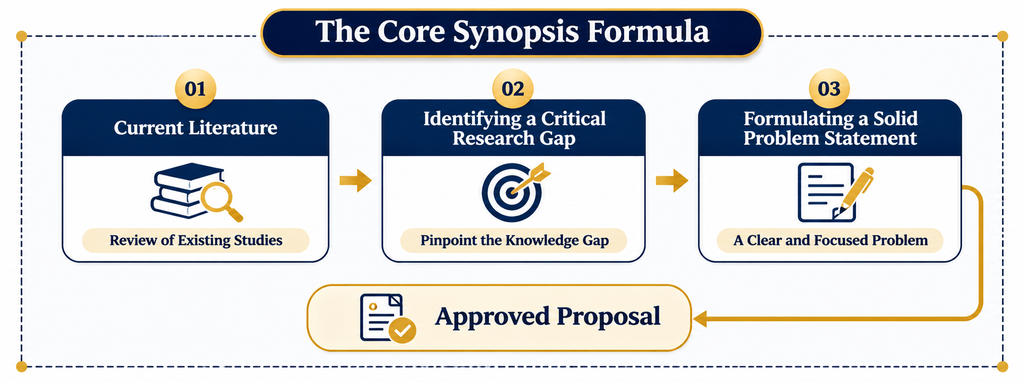
Identifying a genuine research gap requires a systematic evaluation of contemporary literature. Scholars must carefully map out conceptual, methodological, or contextual limitations within existing peer-reviewed studies.
Through the premium research proposal writing support provided by Qundeel Academic Consultancy (Qundeel.com), students learn to transition from broad thematic overviews to precise gap identification. By documenting what has been overlooked by previous researchers, your proposal establishes a strong academic justification that meets stringent university submission requirements.
Developing a Theoretical and Conceptual Framework: Visualizing Variables
An essential requirement that evaluation boards look for in an HEC-aligned proposal is a well-defined theoretical or conceptual framework. A research proposal cannot rely solely on textual explanations; it must visually and logically demonstrate how your independent, dependent, mediating, or moderating variables interact with one another. Supervisors often reject early synopsis drafts because the student has failed to ground their study within an established, verified academic theory.
When you develop your conceptual framework, you must map out every causal relationship based on solid literature. This means your hypotheses must directly stem from identified limitations in previous studies. Through the research proposal writing support at Qundeel Academic Consultancy (Qundeel.com), scholars receive hands-on mentorship to structurally sound out these models. Our panel ensures that your theoretical frameworks are not just decorative diagrams, but statistically testable roadmaps that align perfectly with your eventual data collection instruments.
Methodological Rigor: Sampling Strategy and Data Analysis Design
An HEC-aligned proposal must demonstrate total alignment between its research objectives and the chosen research methodology. Academic boards evaluate a synopsis heavily on whether its data collection procedures, target population boundaries, and sampling strategies are scientifically robust. A vague or incomplete methodology framework is one of the most common reasons supervisor panels delay projects during initial board evaluations.
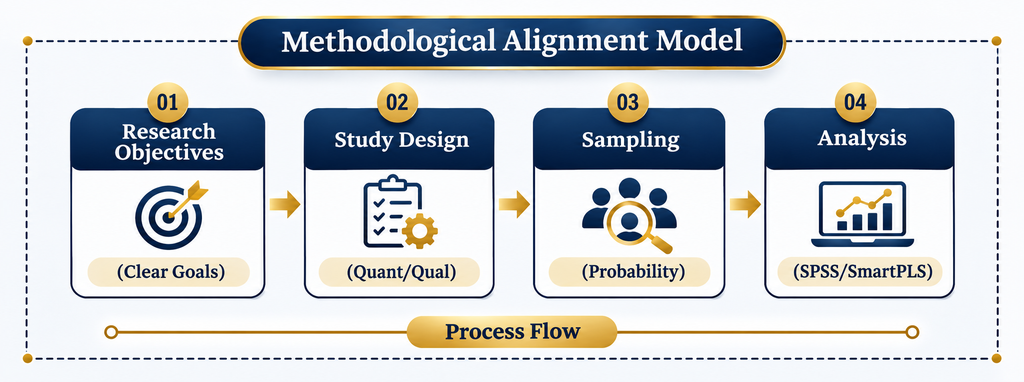
Developing a sound study design demands deep technical expertise across qualitative, quantitative, or mixed-methods frameworks. For quantitative studies, scholars must defend their statistical power, instrument validation steps, and analytical tools such as covariance-based structural equation modeling (CB-SEM) or partial least squares (PLS-SEM).
Through specialized thesis data analysis services, Qundeel Academic Consultancy (Qundeel.com) matches post-graduate scholars with discipline-specific experts who assist in structuring rigorous analysis plans. Whether your methodology relies on advanced statistical modeling in SPSS, AMOS, and SmartPLS, or intricate qualitative coding structures within NVivo, your research roadmap must prove it can produce credible, reliable, and verifiable academic outcomes.
Addressing Ethical Considerations and Institutional Approvals
Modern post-graduate research requires strict adherence to ethical research standards, especially when dealing with human participants, sensitive corporate data, or clinical metrics. Institutional Review Boards (IRB) and university ethics committees demand that every synopsis include a dedicated segment detailing participant confidentiality, informed consent protocols, and data protection measures. Neglecting these ethical boundaries can result in severe compliance delays or complete rejection by university review boards before you even begin data collection.
Your proposal must clearly outline how data security will be maintained throughout the lifecycle of the project from data gathering to final archival storage. At Qundeel Academic Consultancy (Qundeel.com), we emphasize ethical research designs that protect the scholar from future institutional challenges. Our experts help you draft precise consent forms, design non-biased survey questions, and structure anonymity guidelines that fulfill both national HEC standards and international publication requirements, ensuring your dissertation moves smoothly toward final validation.
Maintaining Academic Integrity: Turnitin Compliance and Ethical Submission Standards
The final and most critical phase of preparing an MPhil or PhD research proposal is ensuring absolute academic integrity. Evaluation boards, supervisor panels, and university review chairs use advanced diagnostic software like Turnitin to check every submission for textual overlap and AI-generated content. An otherwise brilliant research blueprint can face immediate rejection if it fails to meet the strict originality benchmarks set by the Higher Education Commission (HEC). This stage demands an uncompromising approach to writing where every argument, conceptual definition, and literature synthesis is drafted from scratch to maintain academic rigor.
+————————————————————————+
| ACADEMIC INTEGRITY CHECKLIST |
| |
| [ Original Text Only ] —> [ Strict Turnitin Similiarity Check ] |
| | |
| v |
| [ University Approval ] <— [ Human-Written Zero-AI Compliance ] |
+————————————————————————+
Achieving a clean, submission-ready manuscript requires precise paraphrasing, accurate secondary source attribution, and structured citation management. Scholars must ensure that their literature reviews, conceptual frameworks, and methodological designs are completely free from superficial prose or automated generation patterns. Most rejections at this final gate happen because students accidentally rely on weak paraphrasing tools or unverified online sources that ruin the linguistic credibility of the research document. To prevent these delays, a thorough line-by-line review of the text, matching citations with references, and manual quality auditing are absolutely necessary before formal board submission.
Through the premium, ethical, and high-quality assistance provided by Qundeel Academic Consultancy (Qundeel.com), post-graduate students are matched with verified domain experts who maintain the highest standards of scholarship. Backed by a dedicated panel of 128+ subject-specific PhD mentors, every project goes through rigorous quality control, structural evaluation, and technical proofreading. This professional oversight ensures that the final proposal naturally reflects deep academic insight and domain authority.
For qualifying full packages, Qundeel offers a unique stamp-paper backed Legal Agreement Facility to guarantee absolute confidentiality, true human-written authenticity, and continuous support through every round of supervisor feedback. Turn your complex variables and raw theoretical frameworks into a validated masterpiece that passes university boards on your very first attempt.
❓ Frequently Asked Questions (FAQs)
What is the standard word count and structure for an HEC-aligned MPhil or PhD research proposal?
An HEC-aligned research proposal typically ranges between 3,000 to 5,000 words, depending on your university’s specific formatting manual. The core structure must include a descriptive title, introduction, background of the study, a well-defined problem statement, specific research objectives and questions, hypotheses, a theoretical or conceptual framework, a comprehensive literature review, a detailed research methodology (sampling, instruments, and data analysis plan), and a clean list of references formatted in APA, Harvard, or IEEE style.
Why do university evaluation boards and supervisors frequently reject a thesis synopsis?
The most common reasons for synopsis rejection include a vague or overly broad problem statement, a failure to explicitly identify a contemporary research gap, misalignment between research objectives and the chosen methodology, and outdated literature citations. Additionally, high similarity scores on Turnitin or any evidence of AI-generated content can lead to immediate rejection by advanced studies review boards.
What is the difference between a conceptual framework and a theoretical framework in a proposal?
A theoretical framework provides the broad philosophical or academic foundation for your study, relying on established, peer-reviewed theories (e.g., Agency Theory, Technology Acceptance Model). A conceptual framework is your specific, mapped-out operational model where you visually and logically illustrate the direct relationships, mediations, or moderations between your study’s independent and dependent variables based on those theories.
How does Qundeel Academic Consultancy ensure that my thesis proposal passes Turnitin and AI-detection checks?
At Qundeel Academic Consultancy (Qundeel.com), we enforce a strict zero-AI policy. Every section of your research blueprint is drafted from scratch by specialized, PhD-qualified subject matter experts. We provide comprehensive line-by-line manual proofreading, accurate secondary source attributions, and precise paraphrasing to ensure your manuscript is 100% human-written and fully compliant with strict university submission thresholds.
Does Qundeel.com provide continuous support if my supervisor requests revisions after the initial submission?
Yes, absolutely. For qualifying full-service packages, our mentorship panel stays with you through every single round of evaluation. Backed by our stamp-paper Legal Agreement Facility, we provide unlimited revisions and adjustments based on official supervisor feedback or university board remarks until your research proposal achieves formal, institutional approval.
Ready to Secure Immediate Approval for Your Synopsis?
Don’t let rigid structural requirements or complex research gaps delay your academic milestones. Get 100% human-written, HEC-aligned research proposal writing support from our panel of 128+ subject-specific PhD experts since 2011.
💡 Confidentiality Guaranteed: Backed by our stamp-paper Legal Agreement Facility for qualifying full packages.
