
Essential Sections of a Strong Research Proposal: A Complete Guide for MPhil, MS & PhD Scholars
 by
by
Why UK PhD Supervisors Reject AI Research Proposals: 12 Common Reasons and a UK Proposal Review Checklist
Estimated reading time: 24 minutes, 1 second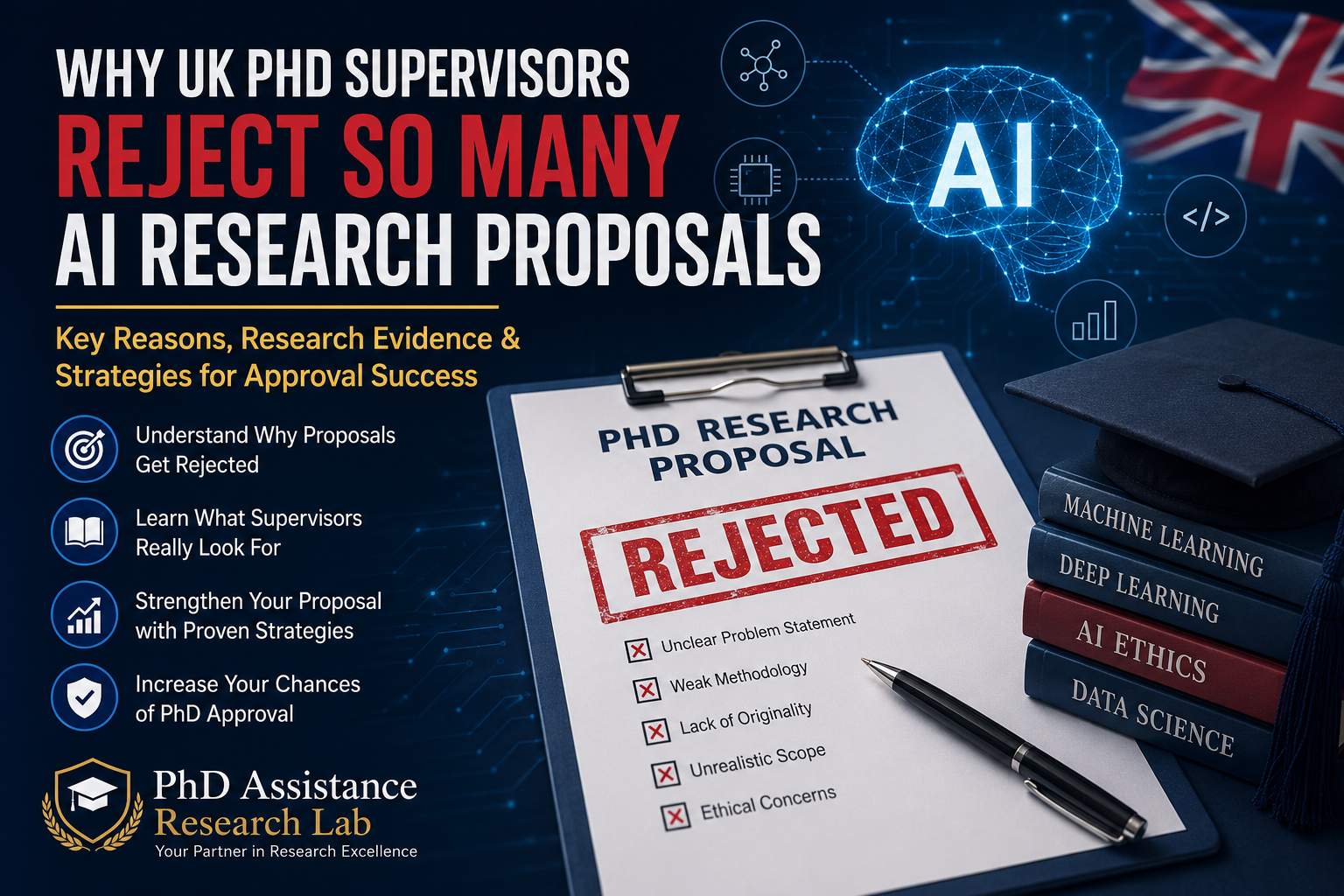
Introduction
UK PhD supervisors are likely to reject AI research proposals when the research problem remains broad, the expected contribution is uncertain, or the proposed methods cannot produce credible evidence. Published guidance from QAA, Manchester, Edinburgh, Cambridge, and UKRI repeatedly expects originality, critical engagement with literature, feasible methods, ethical planning, reproducibility, and clear alignment with available supervisory expertise.
Table of Contents
- Introduction
- Summary
- Key Takeaways
- What UK PhD Supervisors Assess in an AI Research Proposal
- Why AI Research Proposals Receive Greater Academic Examination
- 1. The Research Problem Is Broad or Poorly Defined
- 2. The Literature Review Describes Studies Without Establishing a Research Gap
- 3. The Proposal Starts With an AI Technique Rather Than a Research Need
- 4. The Claimed Originality Is Too Weak for Doctoral Research
- 5. The AI Methodology Lacks Technical and Research Justification
- 6. Dataset Access, Quality, and Representativeness Remain Uncertain
- 7. The Evaluation Plan Cannot Support the Research Claims
- 8. Data Leakage, Overfitting, and Reproducibility Risks Are Ignored
- 9. Ethics, Privacy, Fairness, and Explainability Are Treated as Minor Issues
- 10. The Scope Exceeds the Available Time, Data, and Computing Resources
- 11. The Proposal Does Not Fit the Supervisor or Department
- 12. The Writing Appears Generic, AI-Generated, or Academically Unreliable
- Recommended Structure for a Strong AI PhD Research Proposal
- UK AI PhD Research Proposal Review Checklist
- Why a PhD Research Proposal Writing Service in UK Matters
- AI PhD Proposal Support From Qundeel Academic Consultancy
- Independent Academic Support Notice
- Final Summary
- Frequently Asked Questions
- References
Artificial intelligence research proposals face additional examination because researchers must justify their datasets, algorithms, evaluation criteria, computational resources, data-governance procedures, fairness assessments, explainability methods, and reproducibility arrangements.. An applicant cannot establish doctoral originality merely by applying machine learning, deep learning, generative AI, natural language processing, or computer vision techniques within a different organisational or geographical setting.
The proposed study must define an unresolved research problem and explain how its theoretical, methodological, technical, or applied contribution advances existing knowledge within a manageable doctoral project. The QAA Characteristics Statement requires doctoral research to make an original contribution to knowledge through independent research or an original application of existing knowledge and understanding. This article does not claim a single UK-wide rejection rate because universities assess applications through different departmental, supervisory, funding, and admissions procedures.
Instead, the discussion synthesises recurring expectations within official university guidance, doctoral standards, research-methods literature, responsible AI frameworks, and established machine-learning reporting practices.
Summary
UK supervisors commonly question AI proposals that present fashionable technologies without establishing a focused problem, verified research gap, defensible methodology, accessible dataset, realistic project scope, or original academic contribution. A successful proposal should connect every research question with an appropriate dataset, analytical method, evaluation procedure, ethical safeguard, research output, and feasible doctoral timetable.
Applicants should also explain data access, model selection, baseline comparisons, validation procedures, computing requirements, bias assessment, privacy protection, explainability, software documentation, and reproducibility before requesting supervisory approval.
Key Takeaways
- A broad interest in artificial intelligence cannot replace a specific research problem supported by recent theoretical, methodological, and empirical literature from credible academic sources.
- A research gap must identify unresolved knowledge rather than merely claiming that few studies have examined a technology within one country, industry, university, or organisation.
- The proposal should explain why artificial intelligence provides a suitable analytical response and why simpler statistical, qualitative, mathematical, or rule-based methods remain insufficient.
- Dataset availability, legal access, sample adequacy, class imbalance, missing values, representativeness, privacy restrictions, licensing, and computing requirements should be discussed before model development.
- Evaluation should include suitable baselines, validation procedures, performance metrics, uncertainty estimates, error analysis, subgroup assessment, and safeguards against data leakage or overfitting.
- Qundeel Academic Consultancy provides subject-matched AI PhD Proposal Support, although university admission, supervisor acceptance, funding decisions, and research outcomes cannot be guaranteed.
What UK PhD Supervisors Assess in an AI Research Proposal
A PhD research proposal allows supervisors and admissions reviewers to assess the applicant’s research thinking, disciplinary knowledge, methodological competence, academic independence, and suitability for doctoral study. The University of Manchester explains that proposals are assessed for intellectual purpose, originality, critical thinking, knowledge of relevant literature, methodological planning, ethical awareness, and departmental research fit.
University of Edinburgh guidance asks applicants to identify a clear research gap, formulate realistic objectives, explain their methodology, address ethical matters, and provide a practical project timetable. Cambridge guidance similarly expects the proposal to define a research question or hypothesis, explain the selected methods, and establish the project’s contribution, originality, and feasibility.
Supervisors also assess whether the proposed topic matches their expertise, current research programme, available facilities, data partnerships, laboratory capacity, and ability to provide appropriate supervision. A technically interesting proposal may receive an unfavourable decision when the department cannot identify a suitable supervisory team or provide the required computing and data infrastructure.
Why AI Research Proposals Receive Greater Academic Examination
AI research can produce impressive experimental results even when the underlying research design contains data leakage, inappropriate validation, biased sampling, weak baselines, or excessive model tuning. Kapoor and Narayanan identified data-leakage problems across numerous machine-learning applications and argued that these errors can produce seriously inflated performance estimates and unreliable scientific conclusions.
Pineau et al. connected reproducibility with transparent reporting of code, datasets, experimental conditions, computational requirements, and model-development decisions within machine-learning research. UKRI guidance for artificial intelligence doctoral training specifically addresses reproducible research, professional software practices, data management, ethical data use, data protection, and relevant regulatory requirements.
These expectations mean that an AI proposal must present a defensible research design rather than a collection of technical terms, software names, algorithms, or anticipated accuracy scores.
1. The Research Problem Is Broad or Poorly Defined
An AI topic does not become a doctoral research problem merely because it mentions machine learning, generative AI, computer vision, intelligent automation, or predictive analytics. Statements such as “using artificial intelligence in healthcare” or “applying machine learning in education” identify general fields without specifying the unresolved academic or practical problem.
Creswell and Creswell (2023) explain that a research problem provides the intellectual basis for the study’s purpose, research questions, methods, evidence requirements, and expected contribution. Manchester guidance similarly asks applicants to define their topic, demonstrate awareness of the research context, and explain why the proposed project can make an original contribution.
A focused AI problem should identify the affected population, decision context, existing limitation, available evidence, technical barrier, knowledge deficiency, and consequences of leaving that problem unresolved.
How to Correct a Poorly Defined AI Research Problem
The applicant should define one specific problem, establish its academic and practical significance, identify the limitations of current approaches, and explain why doctoral research remains necessary. The problem statement should lead directly toward the research aim, objectives, questions, selected data, analytical procedures, and proposed contribution without introducing unrelated technological ambitions.
2. The Literature Review Describes Studies Without Establishing a Research Gap
Many AI proposals summarise previous articles individually but never compare their assumptions, datasets, methods, findings, limitations, evaluation practices, or unresolved disagreements. A descriptive literature review confirms that the applicant has read several sources, but it does not establish why another doctoral investigation should receive academic approval.
Booth, Sutton, and Papaioannou (2021) explain that structured literature reviewing requires systematic searching, critical appraisal, synthesis, and transparent reasoning rather than disconnected article summaries. Edinburgh guidance asks applicants to identify a clear research gap and explain how the proposed study differs from existing research within the relevant academic field.
A defensible gap may concern theory, methodology, dataset quality, external validation, model interpretability, demographic fairness, contextual transferability, causal explanation, or implementation evidence.
Weak Research-Gap Statements
Statements claiming that “few studies exist,” “no study has examined Pakistan,” or “limited work has applied AI” remain weak without a transparent search process and critical comparison.
Geographical novelty alone rarely establishes doctoral contribution unless the new context creates a theoretically significant difference, methodological challenge, distinctive dataset, or transferable research insight.
How to Develop a Strong AI Research Gap
Researchers should compare recent studies by research problem, theoretical position, dataset, model, validation strategy, evaluation metric, population, application setting, limitation, and recommended future research. The final synthesis should identify precisely what remains unknown, why that absence matters, and how the proposed research will produce evidence that existing studies cannot provide.
3. The Proposal Starts With an AI Technique Rather Than a Research Need
Some applicants decide to use a transformer, large language model, convolutional neural network, reinforcement-learning system, or generative AI application before defining their research question. This solution-first approach often produces a proposal that promotes a preferred technology without proving that artificial intelligence offers the most suitable response to the research problem.
A doctoral methodology should follow the research question because research design determines which evidence must be collected and how that evidence should be interpreted (Creswell & Creswell, 2023). The researcher should compare AI methods with relevant alternatives, including statistical models, qualitative methods, optimisation techniques, mathematical models, conventional software, and human decision processes.
How to Establish the Need for Artificial Intelligence
The proposal should explain what analytical complexity, data structure, prediction requirement, automation challenge, or adaptive process makes the selected AI approach suitable for the study. It should also explain why simpler methods cannot answer the research questions with equal validity, interpretability, affordability, or practical usefulness.
4. The Claimed Originality Is Too Weak for Doctoral Research
Applying an established algorithm to another dataset does not automatically create a doctoral contribution, particularly when the study repeats existing procedures without theoretical or methodological development. The QAA expects doctoral graduates to demonstrate an original contribution to knowledge through research or an original application of existing knowledge and understanding.
Originality may arise through a new theoretical explanation, methodological procedure, algorithmic development, dataset, evaluation framework, application architecture, causal analysis, or evidence from an underexamined population. A new country or institution can support originality when the contextual differences have theoretical significance and require a justified modification of existing assumptions, models, or methods.
How to State the Proposed Contribution
The contribution section should specify what the study will produce, which existing limitation it will address, who can use the findings, and how the outcome differs from current knowledge. Applicants should separate expected theoretical, methodological, technical, empirical, and practical contributions rather than presenting one general claim that the study will advance artificial intelligence.
5. The AI Methodology Lacks Technical and Research Justification
A proposal remains methodologically weak when it lists Python, TensorFlow, PyTorch, machine learning, deep learning, or generative AI without describing the complete research procedure. Saunders, Lewis, and Thornhill (2023) explain that research design, data collection, analysis, and evaluation choices require explicit justification against the research objectives.
For AI research, that justification should cover dataset selection, preprocessing, feature construction, algorithm selection, training procedures, hyperparameter strategy, validation design, baseline comparison, and statistical interpretation. The methodology should also explain whether the study is predictive, explanatory, causal, experimental, design-science-based, simulation-based, qualitative, quantitative, or mixed-methods in orientation.
Questions the Methodology Must Answer
- The proposal should explain which data will answer each research question and how the researcher will obtain lawful, reliable, and sufficient access.
- The researcher should justify every major model against the problem structure, dataset characteristics, prior evidence, interpretability requirements, and expected computational demands.
- The validation procedure should define training, validation, and testing partitions while preventing information transfer across samples, individuals, locations, institutions, or time periods.
- The evaluation plan should explain why the selected metrics represent meaningful performance within the proposed application rather than merely producing attractive numerical results.
- The methodology should specify which software, hardware, libraries, random seeds, version controls, repositories, and documentation procedures will support reproducibility.
PhD Computer Science Proposal Support in UK should strengthen methodological reasoning rather than adding technical vocabulary without a clear connection to the research questions.
6. Dataset Access, Quality, and Representativeness Remain Uncertain
AI projects depend heavily on data, although many proposals describe model development without proving that an appropriate dataset exists or remains legally accessible. Supervisors may question proposals that rely on private hospital records, confidential business data, platform information, government databases, or commercial datasets without documented access arrangements.
Gebru et al. (2021) recommend detailed dataset documentation covering motivation, composition, collection procedures, intended uses, affected populations, limitations, and possible biases. Dataset limitations may include missing values, label errors, class imbalance, historical bias, restricted demographic representation, inconsistent measurement, data drift, duplicated records, or uncertain consent conditions.
Dataset Questions Supervisors May Ask
- The proposal should identify who created the dataset, why it was collected, which population it represents, and whether that population matches the intended research context.
- The applicant should explain the expected sample size, outcome distribution, missing-data pattern, class balance, annotation process, licensing conditions, and access restrictions.
- The proposal should describe how personally identifiable, commercially sensitive, medical, educational, biometric, or behavioural information will receive suitable protection.
- The researcher should state whether external validation data will be available and whether the final model can be examined beyond its original training environment.
An AI PhD Research Proposal Writing Service in UK should assess dataset feasibility before recommending algorithms, software platforms, performance metrics, or implementation plans.
7. The Evaluation Plan Cannot Support the Research Claims
A proposal may identify several AI models but provide little explanation of how their performance will be compared, interpreted, stress-tested, or connected with the research questions. Accuracy alone may provide a misleading assessment when datasets contain class imbalance, unequal error costs, demographic variation, rare outcomes, or changing real-world conditions.
NIST’s AI Risk Management Framework associates trustworthy AI with validity, reliability, safety, security, resilience, accountability, transparency, explainability, privacy, and fairness. A credible evaluation plan may require precision, recall, sensitivity, specificity, F1 score, area under the curve, calibration, mean absolute error, uncertainty intervals, or application-specific measures.
What a Strong Evaluation Section Should Include
The proposal should define suitable baseline methods, justify every performance metric, explain statistical comparisons, and include error analysis across meaningful populations, conditions, or data sources. Researchers should also discuss external validation, sensitivity analysis, ablation studies, calibration, decision thresholds, confidence intervals, and practical consequences associated with false-positive or false-negative results.
8. Data Leakage, Overfitting, and Reproducibility Risks Are Ignored
Data leakage occurs when information unavailable during genuine prediction enters model development, training, feature construction, selection, or evaluation and produces unrealistically favourable performance. Kapoor and Narayanan (2023) documented several forms of leakage within machine-learning-based science and connected these errors with serious reproducibility failures across multiple disciplines.
Overfitting can also occur when a model learns training-specific patterns that do not transfer to new participants, organisations, devices, geographical areas, or future periods. Pineau et al. (2021) recommend clearer reporting of code, data, experimental conditions, computing resources, and development decisions to support reproducibility within machine-learning research.
How to Address Reproducibility Within the Proposal
The applicant should describe data splitting, preprocessing boundaries, cross-validation, external testing, random-seed management, code documentation, software versions, model selection, and planned repository arrangements. When data or code cannot be shared, the proposal should explain which documentation, synthetic data, pseudocode, metadata, secure-access procedures, or controlled repositories will permit meaningful examination.
9. Ethics, Privacy, Fairness, and Explainability Are Treated as Minor Issues
AI ethics should not appear as a brief paragraph claiming that the researcher will obtain approval and maintain participant confidentiality. AI research may create risks involving personal data, automated decisions, discrimination, surveillance, exclusion, human autonomy, cybersecurity, misinformation, intellectual property, and environmental cost.
The ICO states that AI systems processing personal data remain subject to data-protection principles, including lawfulness, fairness, transparency, accountability, purpose limitation, and data minimisation. UNESCO’s Recommendation on the Ethics of Artificial Intelligence addresses human rights, dignity, transparency, accountability, fairness, environmental sustainability, human oversight, and wider social effects.
The UK’s AI policy framework similarly identifies safety, security, transparency, explainability, fairness, accountability, governance, contestability, and redress as central principles for responsible AI use.
Ethical Questions That Require Early Answers
- The proposal should identify whose data will be processed, which legal basis applies, what consent or governance arrangements are required, and who may experience harm.
- The researcher should explain how bias will be measured across relevant groups and how unequal error rates or discriminatory outcomes will receive investigation.
- The proposal should describe whether participants, professionals, organisations, or affected communities can understand, question, contest, or correct AI-supported decisions.
- The applicant should distinguish technical explainability from meaningful human explanation because feature-importance scores may not satisfy legal, clinical, educational, or organisational needs.
- The study should identify possible misuse, unauthorised access, model inversion, data extraction, hallucination, cybersecurity, and dual-use risks where these concerns remain relevant.
10. The Scope Exceeds the Available Time, Data, and Computing Resources
Many proposals attempt to create several datasets, develop multiple advanced models, conduct international validation, build an application, complete user testing, and develop policy recommendations. Such ambition may appear attractive, although supervisors must determine whether one researcher can complete the project within the available doctoral period and institutional resources.
Manchester guidance asks applicants to identify project stages, annual expectations, anticipated challenges, required resources, access problems, and a realistic timetable. Edinburgh guidance similarly asks researchers to present realistic objectives, a feasible methodology, ethical planning, and a timetable covering research activities and thesis preparation.
Large language models and deep-learning experiments may require costly graphics-processing resources, extensive storage, licensed datasets, technical staff, secure environments, or specialised laboratory facilities.
How to Demonstrate Feasibility
The proposal should identify the minimum research required to answer the central questions and separate essential doctoral work from optional extensions or future development. Applicants should provide a phased timetable covering literature review, ethics, data access, preprocessing, model development, validation, interpretation, writing, dissemination, and contingency planning.
11. The Proposal Does Not Fit the Supervisor or Department
A strong proposal can still receive an unfavourable response when its topic, methodology, sector, dataset, or technical requirements fall outside available supervisory expertise. Manchester advises applicants to contact potential supervisors because early discussion can confirm mutual research interest and determine whether the university can identify a suitable supervisory team.
Edinburgh also advises applicants to identify relevant research groups and academic staff whose expertise matches the proposed project before submitting the formal application. Supervisor alignment requires more than copying keywords from a staff profile because applicants should understand the academic’s recent publications, methods, projects, collaborations, and research direction.
How to Establish Genuine Supervisor Alignment
The proposal should explain how its problem, literature, methods, data, and expected contribution connect with the prospective supervisor’s current academic work. Applicants should avoid sending identical proposals to several departments because generic applications often reveal limited understanding of institutional expertise, research facilities, and supervisory availability.
12. The Writing Appears Generic, AI-Generated, or Academically Unreliable
Generative AI can assist with brainstorming, language checking, structure, and preliminary searching, although unverified output can introduce fabricated references, inaccurate claims, vague arguments, and repetitive prose. The University of Manchester advises applicants that proposals should represent their independent academic thinking and warns against dependence on descriptive AI-generated content.
A proposal may appear AI-generated when it uses broad claims, repeated sentence patterns, unsupported declarations of novelty, invented citations, excessive terminology, or paragraphs disconnected from the stated research questions. Supervisors may also question proposals that discuss algorithms confidently but cannot justify dataset suitability, validation procedures, metric selection, statistical assumptions, or ethical safeguards during an interview.
Responsible Use of Generative AI During Proposal Development
Applicants should verify every citation against the original publication, rewrite ideas through their own disciplinary understanding, and maintain records of sources, notes, and proposal decisions. Any use of generative AI should follow the university’s current application, academic-integrity, authorship, and disclosure policies because institutional requirements may differ between programmes.
Recommended Structure for a Strong AI PhD Research Proposal
1. Working Research Title
The title should identify the central problem, population or application, methodological orientation, and research context without presenting an unverified result or excessively broad technological promise.
2. Direct Proposal Summary
The summary should state the research problem, identified gap, proposed methodology, intended data, expected contribution, and practical feasibility within approximately one focused paragraph.
3. Research Background
The background should explain the academic and practical context while moving quickly from the broad subject toward the specific unresolved problem.
4. Problem Statement
The problem statement should identify what remains unknown, which evidence confirms the problem, who experiences its consequences, and why existing approaches remain insufficient.
5. Critical Literature Review
The literature review should compare theories, datasets, methods, findings, evaluation procedures, limitations, contradictions, and unresolved questions rather than summarising studies separately.
6. Research Gap
The gap section should present a traceable argument from existing evidence toward the exact theoretical, methodological, technical, empirical, or practical deficiency.
7. Research Aim, Objectives, and Questions
The aim should express the study’s overall purpose, while each objective and research question should correspond with data, analytical procedures, and expected outputs.
8. Conceptual or Theoretical Foundation
The proposal should explain which theories, models, concepts, or design principles inform variable selection, interpretation, system development, or evaluation.
9. Research Methodology
The methodology should describe research philosophy, design, data sources, sampling, preprocessing, model development, validation, statistical analysis, software, hardware, ethics, and reproducibility.
10. Expected Contribution
The contribution section should specify how the completed research may extend theory, methods, evidence, technical practice, professional decision processes, or future academic research.
11. Feasibility and Risk Management
The proposal should identify data access, computing requirements, ethical approval, technical dependencies, participant recruitment, potential delays, and practical contingency arrangements.
12. Project Timetable
The timetable should allocate realistic periods for literature development, ethics, data acquisition, analysis, model evaluation, interpretation, thesis writing, revisions, and dissemination.
13. References
The reference list should contain recent and foundational literature directly connected with the research problem, theoretical basis, methodology, application field, and responsible AI requirements.
UK AI PhD Research Proposal Review Checklist
Before sending the proposal to a supervisor, applicants should confirm that every question below receives a clear, evidence-based answer within the document.
- Does the proposal define one specific research problem rather than presenting artificial intelligence as a general research topic or preferred technological solution?
- Does the literature review compare recent studies critically and establish a research gap supported by verifiable academic publications?
- Does the proposed contribution meet doctoral expectations through theoretical, methodological, technical, empirical, or applied originality?
- Does every objective and research question correspond with identifiable data, methods, analytical procedures, and expected research outputs?
- Does the proposal justify why the selected AI approach is more suitable than relevant statistical, mathematical, qualitative, or rule-based alternatives?
- Are dataset access, sample size, representation, licensing, privacy, missing data, class imbalance, annotation, and external validation addressed clearly?
- Does the evaluation plan include suitable baselines, metrics, validation, uncertainty, calibration, subgroup assessment, error analysis, and leakage prevention?
- Are ethics, fairness, explainability, accountability, cybersecurity, human oversight, environmental cost, and possible misuse addressed where relevant?
- Does the applicant explain software, computing resources, technical skills, code management, documentation, and reproducibility arrangements?
- Can the proposed research be completed within the university’s doctoral period using available resources, facilities, partnerships, and supervisory expertise?
- Does the proposal align with the prospective supervisor’s recent publications, research methods, departmental priorities, and current project capacity?
- Has every citation been checked against the original source, with unsupported novelty claims and AI-generated references removed before submission?
Why a PhD Research Proposal Writing Service in UK Matters
Many applicants possess strong programming, professional, or subject knowledge but experience difficulty converting an initial idea into a defensible doctoral research plan. A PhD Research Proposal Writing Service in UK should help researchers connect their problem, literature, research gap, theoretical basis, methodology, ethics, feasibility, and expected contribution.
Effective support should preserve the scholar’s academic ownership while improving structural consistency, methodological justification, critical synthesis, citation accuracy, and alignment with university requirements.
AI PhD Proposal Support From Qundeel Academic Consultancy
Qundeel Academic Consultancy has provided academic research support since 2011 for scholars seeking structured guidance with doctoral proposals, research methods, literature reviews, and supervisor revisions. Our AI PhD Proposal Support may include topic refinement, research-gap assessment, literature organisation, methodology planning, dataset feasibility review, ethical-risk assessment, proposal editing, and university-format alignment.
Subject-matched support can cover artificial intelligence, computer science, data science, cybersecurity, healthcare analytics, educational technology, business analytics, engineering, finance, and interdisciplinary AI applications. Researchers may also request PhD Computer Science Proposal Support in UK for algorithm selection, experimental design, model validation, evaluation metrics, reproducibility planning, and technical-methodology presentation.
Qundeel Academic Consultancy does not promise university admission, supervisor approval, scholarship selection, research results, publication acceptance, or completion within an unverified deadline.
Independent Academic Support Notice
Qundeel Academic Consultancy provides independent academic guidance, editing, research planning, and methodological support without representing any university, supervisor, funding organisation, journal, or admissions authority. The scholar remains responsible for understanding the proposal, verifying every source, following university policies, completing required research activities, and defending all academic decisions before supervisors or admissions reviewers.
Final Summary
UK supervisors expect an AI PhD research proposal to present a focused problem, critical research gap, original contribution, justified methodology, accessible data, credible evaluation, and realistic timetable. AI proposals receive additional examination because technically impressive models can still produce unreliable evidence when data leakage, bias, weak validation, privacy concerns, or reproducibility problems remain unresolved.
Applicants can strengthen their proposals by connecting each research question with suitable evidence, methods, ethical safeguards, evaluation procedures, computing resources, and clearly defined doctoral contributions. Qundeel Academic Consultancy offers PhD Research Proposal Writing Help in UK through subject-matched academic guidance, although the final proposal must remain understandable, defensible, and academically owned by the scholar.
Frequently Asked Questions
Why do UK PhD supervisors reject AI research proposals?
Supervisors may reject proposals that contain broad problems, weak research gaps, uncertain originality, unsuitable methods, unavailable datasets, unrealistic scopes, ethical deficiencies, or poor alignment with supervisory expertise.
Is there an official UK rejection rate for AI PhD proposals?
UK universities do not use one national admissions process, so acceptance decisions depend on departmental criteria, academic competition, supervisor availability, funding, facilities, applicant preparation, and research fit.
What should an AI PhD research proposal include?
A strong proposal should include a focused problem, critical literature review, verified gap, clear questions, justified methods, feasible data, ethical safeguards, evaluation procedures, expected contributions, and timetable.
How can I identify a genuine research gap in artificial intelligence?
Researchers should compare theories, datasets, methods, populations, validation procedures, performance findings, limitations, and future recommendations before identifying an unresolved question that requires doctoral investigation
Is applying an existing AI model to a new country an original contribution?
A different country may support originality when contextual differences change theoretical assumptions, dataset characteristics, implementation conditions, fairness concerns, methodological requirements, or the interpretation of existing findings.
How much technical detail should an AI proposal contain?
The proposal should explain data, algorithms, preprocessing, validation, baselines, metrics, software, computing resources, reproducibility, limitations, and ethics without becoming an implementation manual or completed thesis chapter.
Why is dataset access necessary before proposal approval?
Supervisors must determine whether the researcher can lawfully obtain adequate, representative, appropriately labelled, ethically usable, and technically suitable data within the proposed doctoral timetable.
Which evaluation metrics should an AI proposal use?
Metric selection depends on the research problem, dataset, outcome distribution, error consequences, and application context, so researchers should justify each measure rather than relying exclusively on accuracy.
How should a proposal address AI bias and fairness?
The proposal should identify affected groups, possible sources of bias, subgroup performance measures, fairness definitions, mitigation procedures, human oversight, and limitations associated with the selected approach.
Does an AI proposal need an explainability section?
An explainability section becomes necessary when model decisions affect people, professional judgement, safety, access, treatment, education, employment, finance, public services, or other consequential outcomes.
Can ChatGPT or another generative AI tool write my PhD proposal?
Generative AI may assist with planning or language review, although applicants must verify sources, provide independent intellectual reasoning, follow university policies, and defend every methodological decision personally.
How can I prove that my AI research is feasible?
Applicants should demonstrate data access, technical competence, suitable computing resources, ethical pathways, manageable objectives, realistic milestones, available supervision, and contingency plans for expected research risks.
Should I contact a UK supervisor before submitting my proposal?
Early contact can confirm research interest, methodological fit, supervisory availability, departmental alignment, required facilities, and whether the academic wishes to discuss a revised proposal before formal submission.
Can Qundeel Academic Consultancy guarantee supervisor approval?
Qundeel Academic Consultancy provides independent proposal guidance and academic support, but supervisor approval, admission, funding, ethics clearance, research outcomes, and publication decisions remain outside its control.
What does an AI PhD Research Proposal Writing Service in UK provide?
The service may support problem refinement, literature synthesis, gap identification, methodology planning, ethical assessment, dataset feasibility, proposal structure, academic editing, referencing, and responses to supervisor comments.
References
Booth, A., Sutton, A., and Papaioannou, D. (2021). Systematic Approaches to a Successful Literature Review (3rd ed.). Sage Publications.
Creswell, J. W., and Creswell, J. D. (2023). Research Design: Qualitative, Quantitative, and Mixed Methods Approaches (6th ed.). Sage Publications.
European Commission High-Level Expert Group on Artificial Intelligence. (2019). Ethics Guidelines for Trustworthy AI. European Commission.
Gebru, T., Morgenstern, J., Vecchione, B., Vaughan, J. W., Wallach, H., Daumé III, H., and Crawford, K. (2021). Datasheets for datasets. Communications of the ACM, 64(12), 86–92. DOI: 10.1145/3458723.
Information Commissioner’s Office. (2023). Guidance on AI and Data Protection. ICO.
Kapoor, S., and Narayanan, A. (2023). Leakage and the reproducibility crisis in machine-learning-based science. Patterns, 4(9), 100804. DOI: 10.1016/j.patter.2023.100804.
Mitchell, M., Wu, S., Zaldivar, A., Barnes, P., Vasserman, L., Hutchinson, B., Spitzer, E., Raji, I. D., and Gebru, T. (2019). Model cards for model reporting. Proceedings of the Conference on Fairness, Accountability, and Transparency, 220–229. DOI: 10.1145/3287560.3287596.
National Institute of Standards and Technology. (2023). Artificial Intelligence Risk Management Framework, AI RMF 1.0. NIST AI 100-1. DOI: 10.6028/NIST.AI.100-1.
Pineau, J., Vincent-Lamarre, P., Sinha, K., Larivière, V., Beygelzimer, A., d’Alché-Buc, F., Fox, E., and Larochelle, H. (2021). Improving reproducibility in machine learning research. Journal of Machine Learning Research, 22(164), 1–20.
Quality Assurance Agency for Higher Education. (2020). Characteristics Statement: Doctoral Degree. QAA.
Saunders, M., Lewis, P., and Thornhill, A. (2023). Research Methods for Business Students (9th ed.). Pearson.
UK Government. (2023). A Pro-Innovation Approach to AI Regulation. Department for Science, Innovation and Technology.
UK Research and Innovation. (2023). UKRI Centres for Doctoral Training in Artificial Intelligence. UKRI.
UNESCO. (2021). Recommendation on the Ethics of Artificial Intelligence. United Nations Educational, Scientific and Cultural Organization.
University of Cambridge. (2026). Guidance for Applicants Applying for a PhD. Department of Computer Science and Technology.
University of Edinburgh. (2025). Writing a Research Proposal. Postgraduate Study.
University of Manchester. (2026). How to Write a Research Proposal. Postgraduate Research Admissions.
Yin, R. K. (2018). Case Study Research and Applications: Design and Methods (6th ed.). Sage Publications.
